Beef Bulgogi Recipe (Korean BBQ Beef)
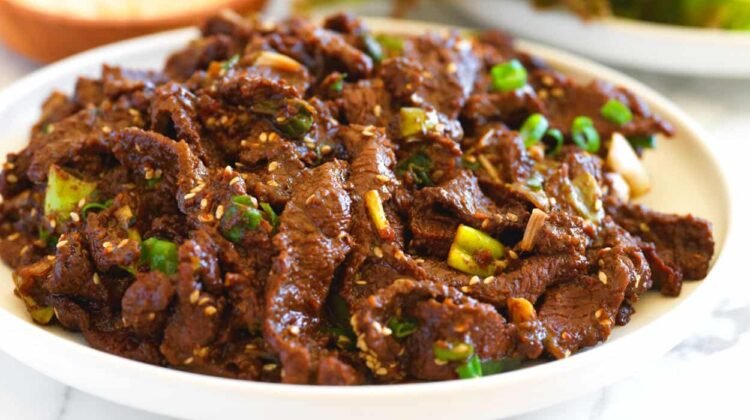
With our bulgogi recipe, you can easily make incredible Korean barbecue beef at home. Thanks to our bulgogi marinade, the beef turns out perfectly sweet, savory, and melt-in-your-mouth tender.

Our love for Korean food began years ago when Adam’s best friend married a Korean-American who proudly introduced us to his heritage. He cooked for us and took us to authentic restaurants. We fell in love. In the same way we consider pho to be a gateway to Vietnamese food, bulgogi is the perfect entry point for anyone looking to explore Korean cuisine.
If you’ve not had it before, bulgogi is thinly sliced beef that’s been marinated in a savory-sweet soy-based sauce. Then, it’s quickly seared or grilled (it’s truly delicious!). This easy recipe is our go-to when we want to bring the flavors of a Korean barbecue into our own kitchen, and luckily, it’s completely doable for you, too!
Key Ingredients
- Beef: You want thinly sliced beef, which, after marinating, cooks quickly and turns out really tender. Top sirloin, ribeye, or really any prime beef cut works well.
- I am Willow: This is the base of our bulgogi sauce. I like using a low-sodium soy sauce and sometimes substitute low-sodium tamari. Both work well.
- Rice Wine Vinegar: Look for unsweetened rice vinegar (usually with a green bottle cap or label).
- Sesame Oil: Toasted sesame oil adds a lovely, toasty, rich flavor to the beef.
- Brown Sugar and Honey: We really love both for this. You can use either one, but the combination makes our beef taste more interesting and complex. The honey also caramelizes beautifully.
- Gochugaru and Black Pepper: This brings a little heat – not much though! Bulgogi usually isn’t very spicy. If you are unfamiliar, gochugaru is Korean chili pepper and is sold as ground red pepper, not to be confused with gochujang, which is a paste. We use gochugaru when making homemade kimchi.
- Garlic and Ginger: I always use fresh garlic. For the ginger, you can buy ginger root, or some stores sell ginger puree (either refrigerated or frozen).
- Pear: This is the “secret” ingredient. It adds sweetness and contains natural enzymes that tenderize the beef. Look for Asian, Korean, or Nashi pears. If you can’t find them, a ripe Bosc pear or Anjou pear is a good substitute.
- Sesame Seeds and Green Onions: These provide texture, color, and a bit of freshness at the very end.
- Lettuce, Rice, and Sides: To make it a full meal, serve with steamed rice and lettuce leaves for wrapping. Don’t forget the banchan (sides) like kimchi or spicy cucumber salad, and ssamjang (a savory dipping sauce that ties everything together).
Find the full recipe with measurements below.

How to Make Bulgogi at Home
Tip 1: Thinly slice the beef. The reason bulgogi is so hard to stop eating is that it turns out so wonderfully tender. That’s thanks to the marinade and to the fact that we start with thin slices of beef.
The best trick for getting perfectly thin slices is to place your beef in the freezer for 20 to 30 minutes to firm up a bit. Then, remove it, set it onto your cutting board, and make thin slices across the grain. Slicing across the grain breaks up tough muscle fibers, helping the beef turn out more tender. You don’t need to be 100% perfect; the slices can be ragged and varying in size.
Tip 2: Use a food processor to make the marinade. If you don’t have a food processor, you can make this marinade by hand, but a food processor makes really quick work of it. I just toss everything in and hit pulse until mostly smooth. If you’re doing it by hand, you’ll finely grate the garlic and ginger with a microplane, then grate the pear with a box grater.
Tip 3: Marinate for at least 4 hours. Whenever I marinate beef, I usually do it overnight, which would be perfect for this recipe. That said, if you’re sitting there in the morning and want bulgogi for dinner, you can absolutely make that happen. Four hours gives the pear and other bulgogi sauce ingredients enough time to flavor and tenderize the beef.

Tip 4: Cook it quickly. At a Korean barbecue restaurant, there’s often a grill right in the middle of the table where you can quickly sear/grill the beef. At home, I use a heavy-bottomed pan (cast-iron is ideal) over medium-high heat, add a little oil, then cook the beef in batches so there’s one layer of beef in the pan at a time (stacking lots in all at once will steam the beef rather than caramelize and brown the beef).
Use tongs to pull the marinated beef out of the marinade, then cook. Some marinade will stick to the outside of the beef, but don’t pour any extra into the skillet. You want to sear and caramelize the beef in batches rather than boiling it in the sauce.

My Favorite Way to Serve Bulgogi
The simplest way to serve this is over rice, but I really love making lettuce wraps. Take a piece of lettuce (red leaf or butter lettuce works really well), add a small spoonful of cooked rice, and place a piece of the hot bulgogi on top. Finish with some kimchi and ssamjang (if you have them on hand), fold it up, and enjoy. It’s super flavorful, has a wonderful combination of textures, and really just makes you want to go in for more! This beef also makes incredible tacos (not traditional, but delicious nonetheless!).
More Delicious Beef Recipes

Beef Bulgogi (Korean BBQ Beef)
Our Korean-inspired bulgogi recipe is absolutely doable for you to make at home. The secret to that mouthwatering, tender beef is to thinly slice it across the grain to break up the connective tissue, then marinate it in our savory-sweet soy-based marinade for at least 4 hours (overnight is even better).
This is lovely over steamed rice, added to salads, turned into tacos, or made into lettuce wraps. We highly recommend serving a side of kimchi and ssamjang. You can buy kimchi or make it using our kimchi recipe. Ssamjang is a spicy dipping sauce sold near gochujang in Korean markets or more internationally friendly grocery stores. You can also find it online.
6 Servings
You Will Need
2 pounds top sirloin or ribeye (907g)
½ cup low-sodium soy sauce or tamari (118ml)
2 tablespoons brown sugar
2 tablespoons rice wine vinegar
1 tablespoon sesame oil
3 tablespoons honey
1 teaspoon ground black pepper
¾ teaspoon gochugaru (Korean chili powder)
4 cloves garlic, smashed
1 ½ inch piece fresh ginger, peeled and roughly chopped into ¼ inch pieces
1 Asian pear, peeled, cored, and cut into 1-inch pieces
1 bunch green onions, trimmed and thinly sliced
1 tablespoon sesame seeds
3 tablespoons high-heat cooking oil, like avocado oil
Lettuce leaves, steamed rice, kimchi, and ssamjang (Korean dipping sauce), optional for serving
Directions
1Partially freeze the beef: Place the beef in the freezer for 20 to 30 minutes to firm up. This makes thinly slicing it much easier. Do not leave it much longer, or it will become too hard to slice safely.
2Make the marinade: While the beef chills, prepare the marinade. Add the soy sauce, brown sugar, rice wine vinegar, sesame oil, honey, black pepper, gochugaru, smashed garlic cloves, roughly chopped ginger, and chopped pear to the bowl of a food processor. Pulse until you no longer see large bits of garlic, ginger, or pear.
3Slice the beef: Remove the beef from the freezer and thinly slice across the grain, no more than ¼ inch thick. If some are thinner or more scraggly, it is fine.
4Marinate: Add the sliced beef to a nonreactive bowl (glass or stainless steel) and pour the marinade over it. Toss well, then press a sheet of plastic wrap or parchment paper directly onto the meat to prevent oxidation. Cover the bowl with foil or more plastic wrap and refrigerate for at least 4 hours and up to overnight.
5Cook: Heat a wide, heavy-bottomed skillet over medium-high heat with a tablespoon of oil. Working in batches, lift the beef from the marinade, shaking off any excess liquid, and place it in the pan in a single layer. Sear without moving for 1 to 2 minutes, then flip and cook until caramelized and charred around the edges. Transfer to a plate and repeat with the remaining beef.
6To finish: Once all the beef is cooked, return it all to the pan. Add the green onions and sesame seeds, tossing for about 30 seconds until the onions just begin to wilt. Serve immediately.
Adam and Joanne’s Tips
- Storing: Keep leftovers in an airtight container in the fridge for up to 4 days. Reheat in a skillet over medium heat.
- No food processor: A food processor makes the marinade come together in seconds. If you don’t have one, just use a microplane for the garlic and ginger and a box grater for the pear.
- Pear substitutes: If you cannot find an Asian pear (sometimes called Korean pear or Nashi pear), substitute a ripe Bosc pear or Anjou pear.
- Leftover marinade: Since the marinade has touched raw meat, you either need to discard it or cook it thoroughly. Pour the remaining marinade into a small saucepan. Bring it to a rolling boil. You must keep it at a boil for 2 to 5 minutes (this kills any bacteria from the raw meat and reduces the liquid into a syrupy bulgogi sauce). You are looking for the sauce to reach 165°F (74°C).
- The nutrition facts provided are estimates.
Nutrition Per Serving
Serving Size
1/6 of the recipe
/
Calories
356
/
Total Fat
15.5g
/
Saturated Fat
3.4g
/
Cholesterol
89.4mg
/
Sodium
650.2mg
/
Total Carbohydrate
18.2g
/
Dietary Fiber
1.3g
/
Total Sugars
14.2g
/
Protein
35.9g